

Products
In recent years, lighting technology has experienced a dramatic shift, moving from traditional fixed fixtures to more flexible, modular systems. Among the rising stars in this transformation are magnetic track lights — a sleek, highly adaptable approach that is increasingly favored by architects, retailers, galleries, and modern homeowners alike. In this article, we’ll explore the key reasons magnetic track lights are gaining traction, their advantages over conventional lighting, and what the future holds for this innovative option.
Magnetic track lighting systems consist of a magnetic rail (or track) that carries power, and lighting modules such as spotlights, downlights, or linear lights that snap magnetically onto the rail. The modules can be repositioned, rotated, or swapped out without rewiring.
Unlike standard track lighting, which requires mechanical connectors or clamps, magnetic systems rely on magnetic coupling to maintain both power and physical attachment, simplifying installation and adjustment.
One of the biggest selling points is how easily modules can be moved or reoriented along the track. Need to shift a spotlight or change its direction? Just snap it into a new position — no tools, no rewiring. This adaptability is especially valuable in retail, galleries, or exhibition spaces where display layouts often change.
Because the modules essentially “float” along the track, magnetic systems lend themselves to sleek, minimal design. The absence of visible fasteners or bulky connectors enhances the modern, high-end appeal. In contemporary interiors, where clean lines are prized, magnetic track lights serve both function and form.
Magnetic systems support a wide array of lighting types — from spotlights and downlights to linear or wall-washing modules. This flexibility means one track can provide accent lighting, ambient lighting, or task lighting simply by swapping modules. The same track that once held a spotlight could tomorrow hold a diffuse linear downlight or a directional beam.
Many magnetic modules are fully dimmable and directional. Their modular design makes it easier to integrate smart controls, sensors, or even adaptive lighting schemes. As lighting design trends move toward smarter, more responsive environments, magnetic systems are well-positioned to adapt.
Since modules are easily detachable, maintenance becomes simpler: you can remove a module to service or replace it without touching the whole track. What’s more, as LED technology evolves, it’s easy to upgrade individual modules rather than replacing entire fixtures or tracks.
| Feature | Traditional Track Lighting | Magnetic Track Lighting |
| Installation complexity | Requires mechanical connectors, sometimes tools | Snap-on, tool-free installation |
| Repositioning modules | Needs loosening of screws or clamps | Instantly repositionable |
| Aesthetic integration | May show visible hardware | Sleek, floating visual effect |
| Upgrade flexibility | Replacing a track is often required | Replace individual modules |
| Maintenance | More cumbersome | Easy module removal |
Magnetic track lighting solves many of the pain points that users and designers face with older systems.
Retail environments constantly change their displays. Magnetic track lighting lets designers reposition accent lights or swap in new modules quickly to match seasonal or promotional layouts.
Art installations often require precise control of light direction and intensity. Magnetic modules allow curators to reposition or reorient lighting as exhibits change, without re-cabling.
Modern restaurants and hotels aim for ambiance flexibility. Magnetic track lights enable flexible lighting adjustments — from warm, diffused downlights to sharp, directed spotlights — depending on the setting or event.
In high-end homes or open-plan living spaces, magnetic track lighting can deliver an effortless, customizable lighting scheme. Changing from ambient to task to accent lighting becomes much easier without new wiring work.
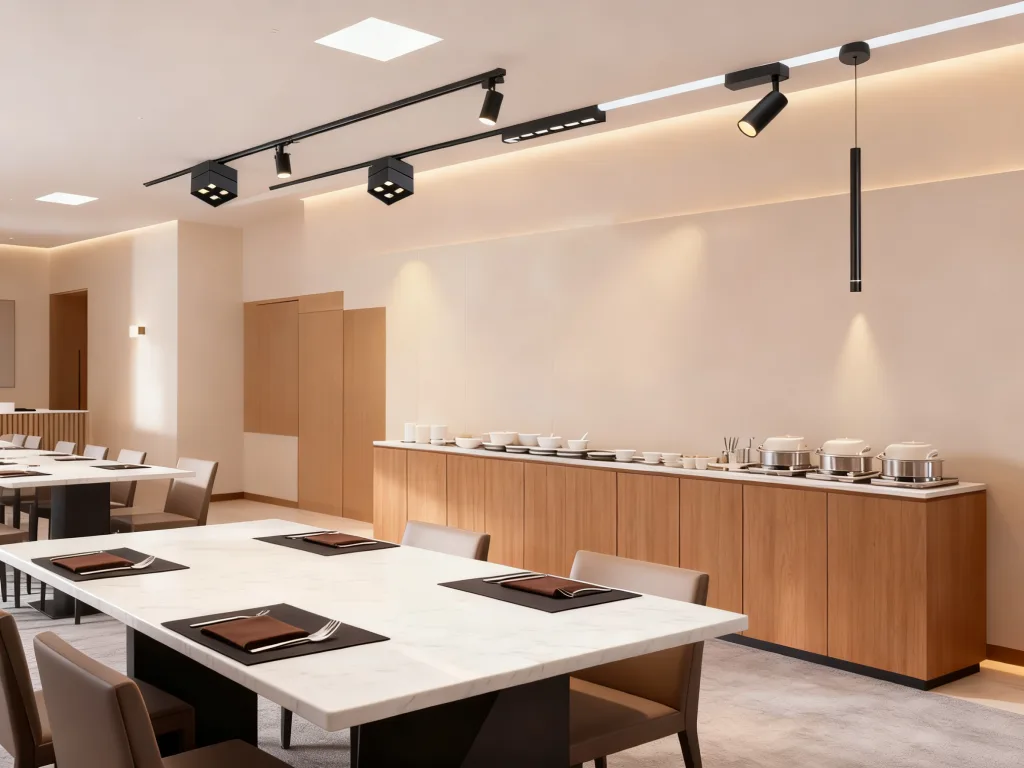
As buildings become smarter, lighting systems need to grow and change. Magnetic track systems are inherently scalable: new tracks and modules can be added easily. This makes them ideal for spaces that may evolve or require phases of lighting upgrades.
Magnetic modules are well-suited to integration with IoT, motion sensors, daylight harvesting systems, and app-based control. As smart buildings become more common, magnetic lighting is ready to play a key role.
Because magnetic track modules are typically LED-based, they benefit from ever-improving LED efficiency. As LED advancements continue, magnetic track lighting can absorb these improvements gradually — through simple module upgrades — rather than forcing complete replacements.
Current aesthetic trends favor minimalism, slender profiles, and the illusion of floating light. Magnetic track lights fit squarely into this visual language. Designers and architects increasingly prefer lighting that naturally blends into interiors, and magnetic modules make that possible.
Magnetic track lighting represents the future of modern lighting design due to its extreme flexibility, aesthetic elegance, ease of maintenance, and readiness for smart integration. As architectural and interior trends continue to push toward modular, adaptive systems, magnetic track lighting offers a clear path forward. Whether in retail, galleries, hospitality, or high-end residential spaces, magnetic lighting is redefining how we light up our environments.
INQUIRY