

Products
Lighting is an integral part of interior design. It doesn’t perform just the elementary functions of illumination but also directly influences the visual effect and atmosphere of the space. Downlights and spotlights are the two most popular lighting options in modern interior design.
Downlights are usually embedded in the ceiling and provide uniform light suitable for basic lighting in large areas. Spotlights focus a narrow beam of light on an area and are used to highlight specified areas or objects. These two lamps have different functions and styles, which suit different scenarios and needs.
This article will elaborate on a detailed comparison between downlights and spotlights, helping you to understand the respective advantages and applicable scenarios of both lighting methods. From an in-depth analysis of their respective characteristics, applications, and design effects, you can then make the most appropriate choice according to your needs.
First, let’s take a look at downlights. This type of lamp is very common in modern lighting design and is popular among the public for its simplicity and practicality.
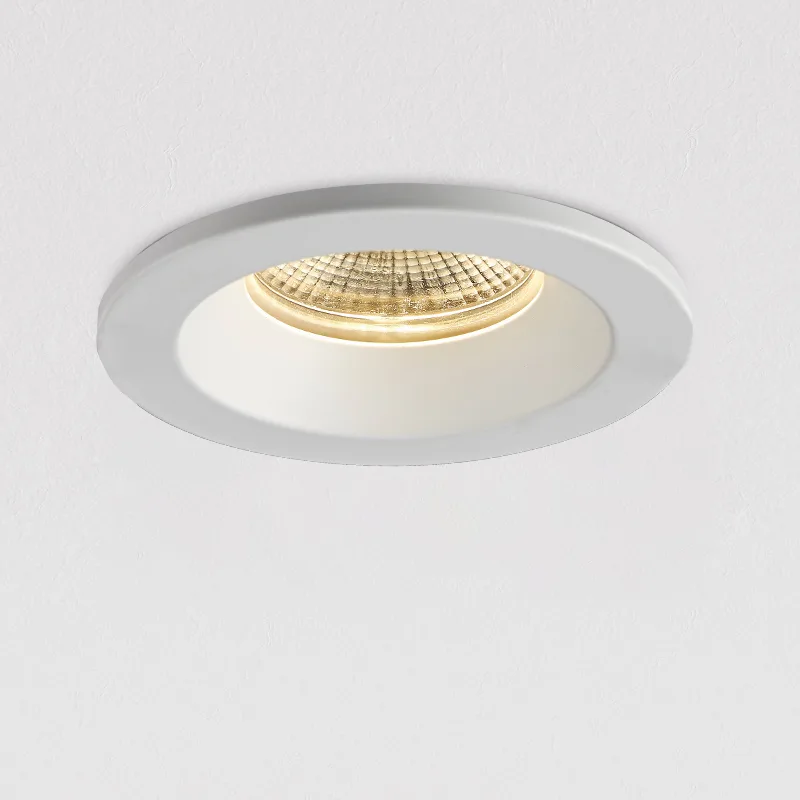
As one of the most common types of recessed lamps in modern lighting design, downlights are usually installed inside the ceiling.
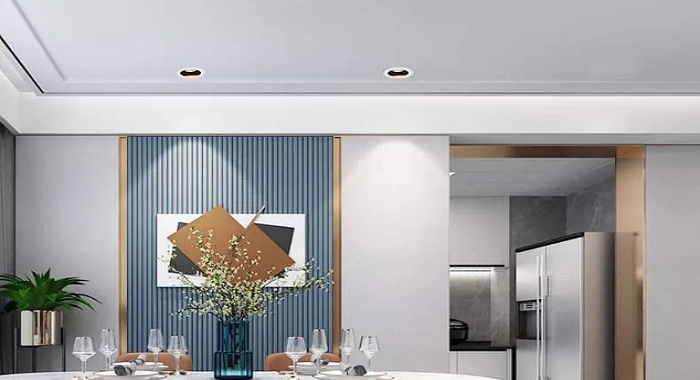
In terms of design, it makes the lamp almost completely hidden, leaving only a small opening for the light source, giving a simple and neat visual effect. The light of the downlight is mainly projected downward, and the directional lighting can illuminate each corner of a room very effectively.
Due to their even light dispersion, downlights are quite suitable for ambient lighting or large-area lighting. In larger rooms, downlights can provide a wide and even light coverage area, ensuring that every corner is well illuminated.
The biggest advantage of downlights is their low-key and unobtrusive appearance. Downlights are embedded in the ceiling so that they almost integrate into the surrounding environment.
Compared with other lamps, they do not interfere too much with the overall style of interior design but can provide stable light support for the space. Therefore, downlights are almost the first choice for many designs pursuing a minimalist style.
Downlights are also highly effective in distributing light. By projecting light downward, they can provide uniform illumination over a large area. This feature makes the downlights very suitable for ambient lighting, particularly when the areas are large.
Besides that, modern downlights are designed with LED light sources, which are not only bright but also energy-efficient and have a long lifespan, saving energy and maintenance costs for users.
While downlights are excellent for ambient lighting, their flexibility in directional lighting is limited. Downlights normally project light downward and are not as flexible as spotlights in illuminating certain areas or placing emphasis on specific decorative objects. For places where certain artworks or pieces of furniture need to be highlighted, downlights might not provide the desired focusing effect.
What’s more, the installation location of downlights will affect the lighting effect. Once installed, it is difficult to adjust or reposition, thus in situations where flexible lighting solutions are needed, downlights may not be the best option.
Downlights have broad applications in lots of places, such as kitchens, living rooms, corridors, and bathrooms, providing an ideal general lighting solution.
As for the kitchen, this bright light of downlights allows users to see clearly while cooking. In the living room, downlights create a warm and comfortable atmosphere due to the uniform dispersal of light. No matter which space it is, they can provide sufficient light to meet the various needs of different daily activities.
The design concept of the downlight itself is highly in line with the modern minimalist home style. Because it can be embedded into the ceiling, the downlight is almost invisible without influencing the integral sense of space or visual effect.
The low-key design can be mixed with any decorative style and make the ceiling look much cleaner and neater. Through proper layout, downlights will effectively function to create light without affecting the original simplicity of the beauty space.
After understanding the basic characteristics and applications of downlights, let’s dive into the functions and advantages of spotlights.
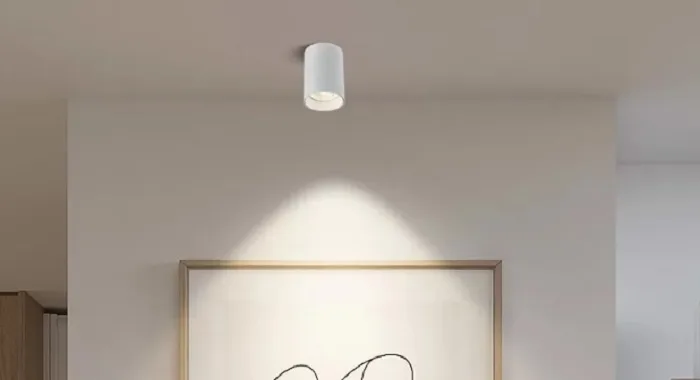
A spotlight can be defined as a light that is specifically designed to focus a beam of light in a specific direction. Opposed to the diffused light emitted by the downlights, spotlights provide very narrow beams of light, so precise lighting effects can be achieved.
Spotlights are effective in accent lighting or task lighting wherein this can outcrop the elements or parts in the space. For instance, they are used in the home to light up paintings or other decorative items on the wall and make those elements the visual centerpiece of the space.
In a commercial setting, spotlights can help illuminate display areas, allowing customers to get a better look at certain products and thus generate interest in purchasing.
One of the primary advantages that come with spotlights is their accurate lighting. The focused beam enables these light sources to deliver precise illumination to a specific area or object. This makes them very ideal for use in either areas or objects that require accent lighting.
Spotlights are mostly adjustable, and it would be rather easy to change the direction and angle of illumination. Because they are flexible, spotlights can be used in many situations, such as highlighting particular areas or illuminating corners.
They are also excellent at creating ambiance. Through the regulation of light direction and its intensity, they can produce artistic or dramatic moods besides serving functional lighting.
For instance, high brightness is used in a product display to show product details, whereas low brightness is utilized in restaurants to create a cozy dining atmosphere.
While there are a lot of advantages to having spotlights, there are also some potential disadvantages. The first is that the look of spotlights may be a little too obvious and may intrude on a certain interior design. For instance, in a minimalist space, a highly perceptible spotlight may go against the general design concept and lead to visual discord.
Furthermore, the nature of the directional lighting that spotlights are designed for requires that they be placed very precisely to avoid bright spots of light or shadows that would create an uneven effect that would interfere with the aesthetic appeal of the place.
Spotlights have many uses and are effective in applications whereby specific elements must be highlighted.
They can be used also in a residential environment, such as picture lighting in the living room or counter lighting in the kitchen. This increases not only the practicality of the house but also the beauty of the area.
Spotlights are also used in commercial environments in the display of products or artworks. For example, in a clothing store, they could be used as spotlights on the clothes to illuminate colors and details to attract customer’s attention, while in an art gallery, they are used to throw light on paintings for better visual effects.
Now that we have clearly explained what downlights and spotlights are, let’s look at their main differences. Although both are common lighting options, there are significant differences in light distribution, design aesthetics, uses, and energy efficiency.
The first big difference between downlights and spotlights lies in the distribution of their light. Downlights provide wide and even light distribution. They are installed in the ceiling, with the spread of the beam at a big angle, which uniformly illuminates the rooms with ambient light.
Compared to downlights with broad light, spotlights can be narrowly focused and have high concentration. The beam angle of a spotlight normally ranges from several degrees to tens of degrees. This small angle can focus on an area or object to achieve an accurate light effect.
Downlights are low-key in design and unadorned, not highlighting their decorativeness, while more emphasis has been put on functionality. They are usually installed inside the ceiling, with the fixture itself almost invisible, with only the base showing.
This hidden design allows downlights to perfectly blend in a room without interfering with the overall style of the interior. Their minimalist outlook will be highly applicable in modern and minimalistic interiors, serving powerful functions of lighting, while their presence remains unobtrusive.
Unlike a simple, invisible downlight, a spotlight itself is often an eye-catching decoration. The appearance of the spotlights usually carries a unique aesthetic feeling, some can even enhance the overall decorative effect.
Most spotlight fixtures can flexibly adjust to enhance functionality and make the visual effects excellent. Spotlights are used not only as a means of lighting but also as a decoration in space design.
Downlights are primarily used in providing general or ambient lighting. They are normally installed in living rooms, kitchens, hallways, and bathrooms because they have a wide distribution of light and can cover the whole space effectively.
The soft, even light provided by downlights allows every corner of the room to be fully illuminated, which is ideal for daily lighting that needs to be used for a long time. In commercial settings, downlights are also commonly used for ambient lighting in offices and public spaces.
The primary purpose of spotlights is for accent lighting or task lighting. Since the light beam is focused and accurate, spotlights are frequently used to highlight specific objects or areas within a room.
For example, in the home, spotlights can be used to illuminate artwork on the wall or collectibles on display shelves. In commercial displays, spotlights can enhance the visual appeal of displayed items by highlighting the characteristics of the items through the strong light concentration effect.
The energy efficiency of downlights usually depends on the type of light source applied and how the lamp is designed. For example, LED downlights are generally more energy-efficient compared to their traditional halogen or incandescent bulbs in general.
Since LED downlights consume very little energy, have a long lifespan, and emit very little heat, they are energy-saving and environmentally friendly. The wide light distribution from the downlight reduces the number of lamps that can be used to provide light for the area, further reducing energy consumption.
The energy efficiency of spotlights depends on the concentration of the beam and the scenario in which they are used. Because of the directional beaming of the spotlights, they directly light up the required area rather than wasteful dispersion of their light due to which ineffective scattering of light occurs.
However, in most cases, spotlights require higher brightness so that the lighting effect is prominent, and therefore energy consumption may be a little more than as compared to downlights.
Downlights and spotlights differ in their characteristics and relative advantages for different application scenarios. So how to choose between downlights and spotlights? We will help you make the best choice for you from multiple perspectives, including room purpose, size and layout, design aesthetics, and installation and maintenance.
The purpose of the room should be the first consideration when selecting a light, as different uses require different lighting needs. Downlights and spotlights have varying advantages when it comes to meeting these different needs.
Downlights are for uniform ambient lighting and are usually suitable to meet the overall needs of the room. This type of lamp is embedded in the ceiling, with large and even light spreadings. They are ideal for use in a living room or bedroom, giving a feeling that light flows naturally from the ceiling.
Spotlights are more suited for task lighting or even focal lighting. If you want some area or objects to become highlighted in the space, for example, an art display area, you will want to use spotlights. This is because they can focus the light and emphasize areas or objects more clearly and brightly.
Besides purpose, size and space layout are another direct influence on lamp selection. Different layouts or sizes of a space would demand different lighting.
Downlights work very well in large rooms or open layouts, such as living rooms, dining rooms, and open kitchens. They are designed to be embedded in the ceiling so as not to interfere with the spaciousness of the room.
Therefore, the technique of invisible installation makes downlights particularly suitable for those whose purpose is keeping a simple and open design, such as a modern home with large windows, white walls, and spacious space.
You can arrange multiple downlights at a certain distance to ensure uniform lighting coverage throughout the room, creating a balanced and well-lit environment.
Compared to downlights, spotlights are mainly applied to small and concentrated areas, such as kitchen counters, reading corners, or display cabinets that require accent lighting. As they can focus light and highlight specific areas and objects.
They are very flexible and also can be installed on tracks. The direction of the beam can be easily changed when necessary. Therefore, spotlights are very suitable for small spaces or local areas with clear functions and highly concentrated lighting needs.
Lighting design not only influences functionality but is also closely linked with the design aesthetics of the room. There are also aesthetic style differences between downlights and spotlights.
The design of the downlights is of an embedded type, which is very suitable for modern minimalist interior decoration. They are embedded in the ceiling and do not occupy any apparent space, hardly interfering with the overall design of the room.
Their simple look makes them the first choice for those who pursue a simple, minimalist design style, especially for home styles that want to keep the space clean and smooth lines.
Compared with downlights, spotlights are more noticeable. During the design process, they are not only a lighting tool but also an important decoration in space.
Compared to low-key downlights, spotlights are more eye-catching. Because their light is concentrated and brighter, they can highlight specific areas or objects, so that people can be attracted at first glance.
Spotlights are also designed to be more expressive. They not only meet the lighting needs functionally, but also add a sense of hierarchy and dramatic effect to the space aesthetically.
Whether choosing downlights or spotlights, the convenience of their installation and easiness of maintenance should be considered. There are big differences in the installation and post-maintenance of different lamps.
Downlights need to be installed on the ceiling, so when installing, space must be set aside on the ceiling and professionals are required to arrange the lines. This means installation of downlights requires more planning in a new home or during any renovation, and more budget consideration is necessary for their installation.
However, once installed, downlights have relatively less maintenance, and because of their hidden design, they do not easily accumulate dust during long-term use.
Spotlights are relatively simple to install, especially track spotlights, which can flexibly adjust the position and direction of the lamps as needed. This flexibility makes them ideal for homes or spaces where lighting needs are frequently adjusted.
However, spotlights are usually more conspicuous, so the surface of the lamps needs to be cleaned frequently to avoid dust accumulation that affects their beauty and light effects.

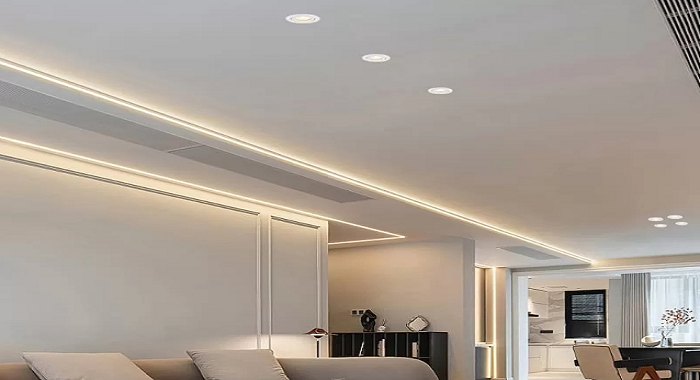
You can also achieve optimal lighting effects by cleverly combining downlights and spotlights. Downlights are suitable for providing basic overall lighting with their evenly distributed light, while spotlights can focus light on specific areas or objects.
When downlights and spotlights are rationally used in the same space, it can be seen that they effectively improve the functionality and aesthetics of the space.
Downlights are usually embedded in ceilings to uniformly light the rooms without occupying any space, so they are able to meet the requirements for large-area basic lighting. They can effectively avoid shadows and create a bright and open environment.
At the same time, spotlights can be adjusted at angles to accurately illuminate specific areas or objects, such as artworks, decorative furniture, or reading corners. With this combination, space is not only fully illuminated but also more visually vivid.
For example, in a living room, downlights can be installed on the ceiling to provide bright basic light for the entire space, while spotlights can be used to illuminate the TV wall, artwork, or decorative walls to create a sense of visual hierarchy.
In this case, downlights provide the necessary lighting for daily activities, while spotlights add a sense of design to the room and attract people’s attention.
Layered lighting, as often defined, is the use of different types of light sources and methods of lighting within one space with a dual purpose of functionality and aesthetics. By layering the lighting, it is possible to develop more depth and dimension within the space.
Downlights can be the base layer that provides soft, even overall lighting to ensure brightness and openness in the room. Spotlights serve as accent lighting, highlighting specific areas or objects through concentrated beams, adding a sense of layering to the space.
This lighting method not only meets daily lighting needs but also can be flexibly adjusted according to different scenes to create different light and shadow effects.
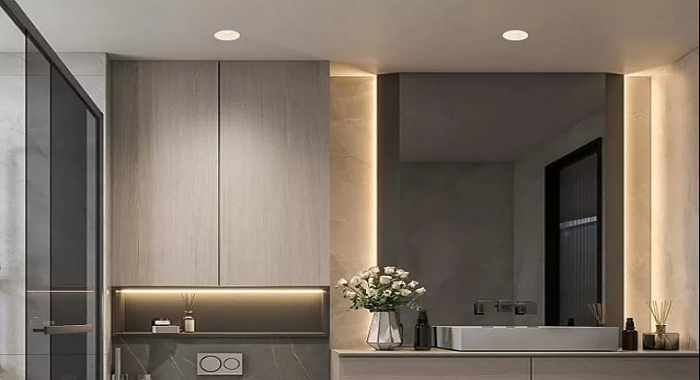
Downlights can provide uniform general lighting, suitable for larger rooms or areas requiring uniform lighting. Spotlights, because of their concentrated light, are ideal for areas or objects that require intensive lighting.
When choosing between spotlights and downlights, consider the purpose of the room, room size and layout, design aesthetics, and installation and maintenance. Keeping these in mind will help you make smart choices and make lighting more practical and atmospheric.
In fact, the best way is not to choose only spotlights or downlights, but to combine the two, which will have a better effect. While downlights provide a wide range of general lighting, adding spotlights in certain areas can make the whole space more attractive.
Whether in a home, office, or business environment, Toseo’s spotlights and downlights are ideal for lighting solutions due to their superior design and functionality.
INQUIRY